Linen management in a hospital operates on a different level entirely. The volumes are large, the hygiene requirements are non-negotiable, and the consequences of getting it wrong extend well beyond operational inconvenience. In a clinical environment, linen is not just a facility management concern. It is an infection control one.
A hospital processes patient linen, OT linen, staff uniforms, and general ward textiles every single day without exception. There are no slow seasons, no reduced-occupancy weekends, and no room to run short. Every piece of linen that comes into contact with a patient carries an infection control implication. Every linen shortage has a direct operational impact on ward functioning.
Yet despite all of this, linen management in many hospitals across India remains under-resourced, poorly tracked, and treated as a back-office concern rather than a clinical one. The result is a set of recurring challenges that drain budgets, create compliance risks, and put unnecessary pressure on nursing and housekeeping staff.
This blog looks at the most common of those challenges and explains how hospital linen rental services, when structured properly, can resolve them in a way that in-house management rarely can.
Challenge 1: Maintaining Infection Control Standards Consistently
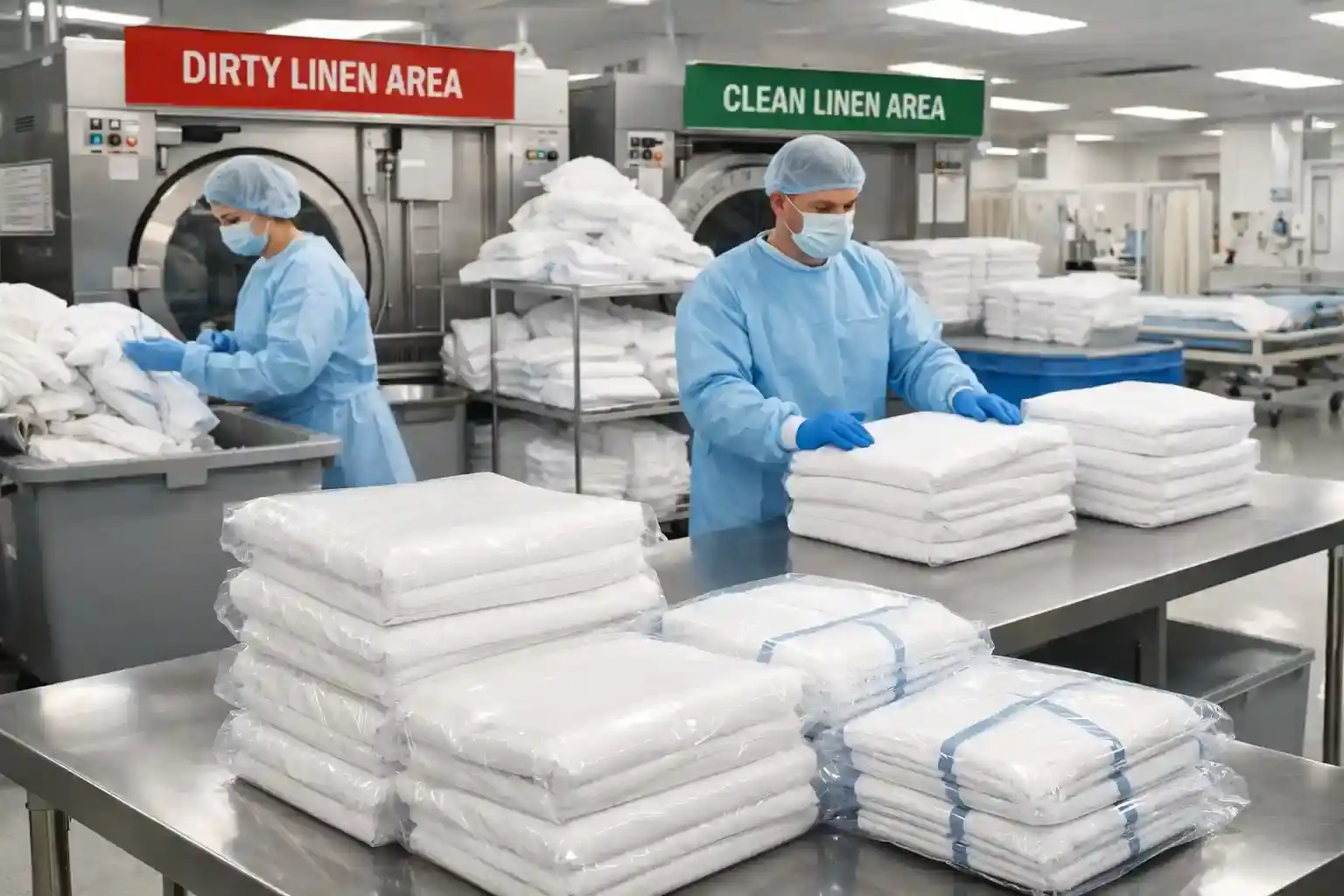
Infection control is the most critical dimension of hospital linen management, and also the most demanding. Patient linen, particularly from isolation wards, intensive care units, and operation theatres, must be processed under strictly defined protocols. This means correct segregation at the point of collection, appropriate bagging and transport, specific wash temperatures, validated disinfection cycles, and controlled handling post-wash to prevent recontamination.
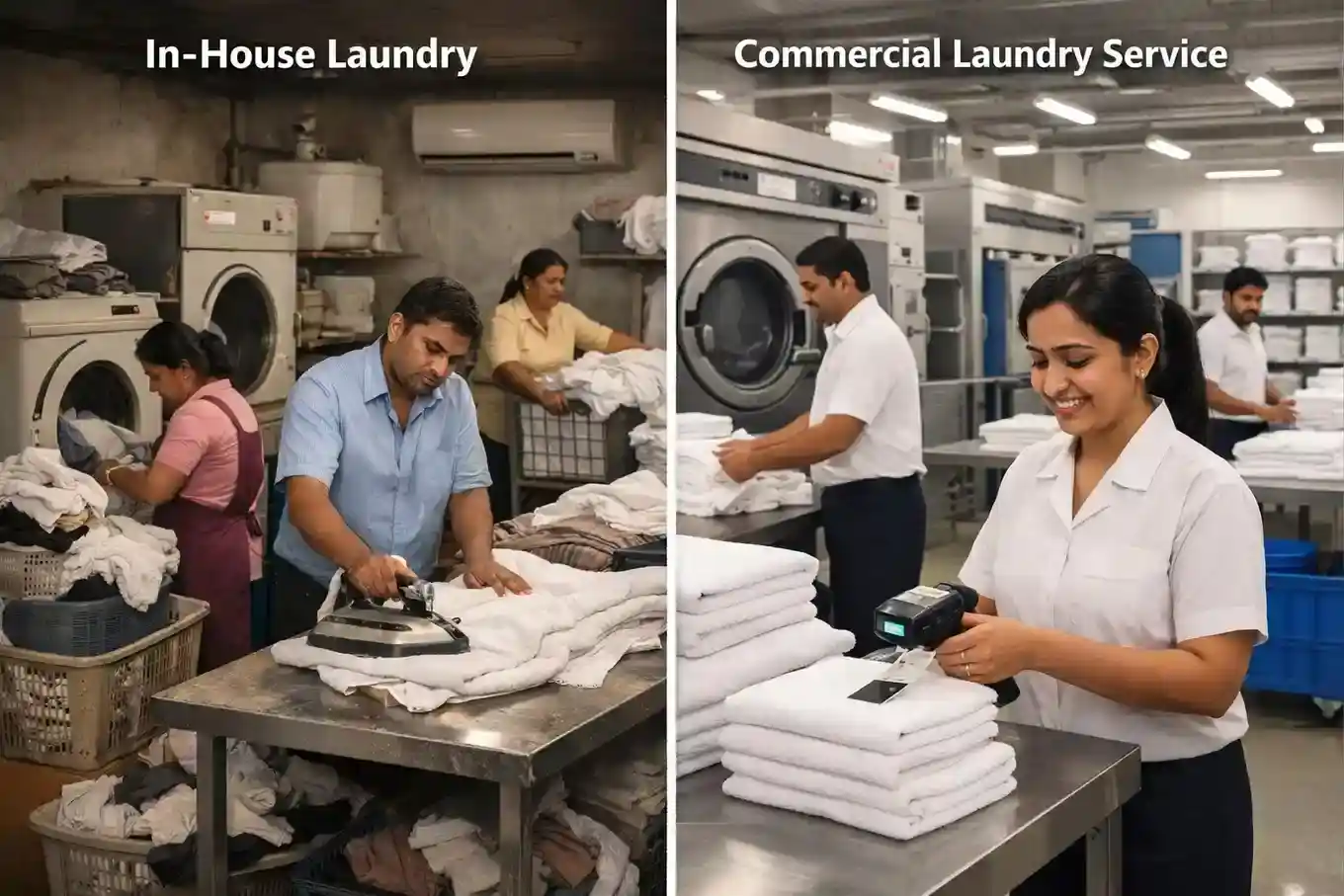
In-house laundry setups in hospitals often struggle to maintain these standards consistently. Equipment is not always calibrated correctly, staff may not be adequately trained on infection control protocols, and there is rarely a system in place to validate that each load has been processed at the required temperature for the required duration.
Hygienic patient linen outsourcing to a specialist provider solves this at the root. Professional healthcare linen processing facilities operate under documented infection control procedures, use validated thermal and chemical disinfection protocols, and maintain records that can be produced during NABH audits or regulatory inspections. The hygiene assurance is built into the system rather than depending on individual staff compliance on any given day.
Challenge 2: Managing High and Unpredictable Linen Volumes
Hospital bed occupancy fluctuates. An outbreak, a mass casualty event, or simply a busy admission week can push linen demand well beyond normal levels with very little warning. An in-house laundry operation is sized for average demand, not peak demand. When volumes spike, the system struggles: machines run continuously, staff work overtime, and linen stocks run thin.
Sizing the in-house operation for peak demand, on the other hand, means significant excess capacity and cost during normal periods. There is no good equilibrium when you own the infrastructure.
Medical linen supply on rental sidesteps this problem entirely. The rental provider maintains the inventory and the processing capacity. When a hospital's needs increase, the provider scales the supply. When demand normalises, so does the volume. The hospital is never over-invested in infrastructure it does not need or under-resourced during a surge.
Challenge 3: Linen Loss, Shrinkage, and Poor Inventory Visibility
Linen loss is one of the most persistent and costly problems in hospital operations. Items go missing from wards, get mixed into clinical waste bags, leave the facility with patients or staff, or simply disappear somewhere between collection and return. Most hospitals have a rough sense that linen is going missing but very little visibility into exactly where, how much, or at what rate.
Without accurate tracking, hospitals tend to over-purchase to buffer against losses they cannot control. This inflates procurement costs without solving the underlying problem. The linen budget keeps growing while the actual linen availability remains unreliable.
RFID-based linen tracking, which is increasingly a standard feature in professional hospital linen rental services, changes this entirely. Each piece of linen is individually tagged and scanned at every stage of its journey, from ward collection through processing and back to the ward. Hospital administrators can see exactly how many pieces are in circulation, how many are in the wash, and when items have not returned as expected. Shrinkage becomes quantifiable and therefore manageable.
Challenge 4: The Capital and Operational Burden of In-House Laundry
Running an in-house laundry in a hospital requires sustained investment across multiple fronts. The equipment alone, industrial washers, dryers, flatwork ironers, and finishing machines, represents a significant capital outlay. Add to that the ongoing costs of maintenance contracts, chemical procurement, water and electricity consumption, and the salaries of dedicated laundry staff, and the true cost of in-house hospital laundry becomes substantial.
Beyond the direct costs, there is the management overhead. Someone in the hospital has to oversee laundry operations, handle staff scheduling, manage breakdowns, ensure compliance, and deal with the day-to-day variability of running a processing facility inside a clinical environment. This pulls administrative and facilities management capacity away from the hospital's core function.
Hospital linen rental services convert all of this into a single, predictable, outsourced cost. The provider owns the infrastructure, employs the staff, and takes on the operational responsibility. The hospital pays for a service and gets a guaranteed outcome, which is far easier to budget for and far less disruptive to manage.
Challenge 5: Linen Quality Degradation Over Time
Hospital linen takes a beating. Frequent washing at high temperatures, exposure to blood and bodily fluids, bleaching for disinfection, and the sheer volume of cycles each item goes through means that linen degrades faster in a healthcare setting than almost anywhere else.
In-house operations rarely have a robust system for monitoring wash counts or assessing linen condition objectively. Items stay in circulation long after they should have been retired, either because no one is tracking them or because the budget for replacement has not been allocated. The result is linen that is thin, discoloured, or structurally compromised, which creates both a hygiene risk and a poor patient experience.
Under a rental model, linen quality is the provider's responsibility. The provider has a commercial interest in maintaining quality standards because their service contract depends on it. Linen is monitored across its lifecycle, retired at the appropriate point, and replaced without the hospital having to budget separately for procurement. The hospital always has access to linen that meets the required standard, without having to manage the replacement cycle itself.
Challenge 6: Compliance and Accreditation Readiness
NABH accreditation and other healthcare quality standards place specific requirements on linen and laundry management. These include documented procedures for linen segregation and handling, evidence of correct wash and disinfection protocols, records of linen inventory and condition, and controls to prevent cross-contamination between clean and soiled linen.
Many hospitals find this documentation difficult to produce consistently from in-house operations where processes are informal and record-keeping is inconsistent. Preparing for an accreditation audit often means a scramble to reconstruct records that should have been maintained all along.
A professional hygienic patient linen outsourcing partner operates with this documentation as a baseline requirement. Compliance records are maintained continuously, process validation is built into the system, and audit preparation becomes a matter of retrieving records rather than constructing them.
How Quick Smart Wash Addresses These Challenges
Quick Smart Wash has been working with hospitals and healthcare institutions across India for over 13 years. Their hospital linen rental services are built around the specific demands of clinical environments, where hygiene compliance, volume reliability, and inventory accuracy are non-negotiable.
Their processing facilities use high-capacity automated laundry plants with validated disinfection protocols suited to OT linen, patient linen, and general ward textiles. RFID-based linen tracking gives hospital administrators full visibility into their linen inventory at every stage of the cycle. And because the linen is supplied on a rental basis, hospitals are never responsible for procurement, replacement, or end-of-life management.
For hospitals that prefer on-premises processing, Quick Smart Wash can also set up and operate a fully managed laundry facility within the hospital itself, covering all capital expenditure, operational costs, staffing, and compliance management. The hospital gets the convenience of on-site processing without any of the operational burden of running it.
Linen Management Is a Clinical Concern, Not Just an Operational One
The challenges described in this blog are not unique to any one hospital. They are systemic issues that arise when linen management is treated as a low-priority back-office function rather than what it actually is: a critical support service with direct implications for patient safety, infection control, and operational continuity.
Medical linen supply on rental, managed by a provider with the right infrastructure and the right processes, is one of the most effective ways to bring these challenges under control. It shifts the burden to a specialist, brings professional-grade standards to a function that demands them, and frees hospital management to focus on care delivery rather than linen logistics.
If your hospital is dealing with any of the challenges outlined above, it is worth exploring what a structured linen rental arrangement could look like for your facility.
About Md Shaquib
Md Shaquib enjoys blogging and content writing, sharing useful stories and tips online.