Every large facility that manages linen at scale, whether a hospital processing hundreds of kilograms of patient linen daily or a hotel turning over rooms across multiple floors, deals with the same quiet, persistent problem: linen disappears. Not all at once, and not always in ways that are easy to explain. It goes missing from wards and rooms, gets bundled into the wrong bag, leaves the premises without being logged, or simply vanishes somewhere between soiled collection and clean return.
The frustrating part is that most facilities know this is happening. What they lack is the visibility to quantify it, trace it, or prevent it systematically. The typical response is to over-purchase, buffer stocks with extra inventory, and absorb the cost as an unavoidable operational loss. Over time, that loss compounds.
RFID linen inventory management changes this fundamentally. When integrated into a broader set of linen management solutions, RFID technology gives facilities the kind of real-time, item-level visibility that makes inventory leakage both measurable and controllable. This blog explains how it works, why it matters, and what a well-structured linen management system looks like when it is built around this technology.
Understanding the Scale of Linen Leakage
Before looking at solutions, it is worth understanding just how significant this problem tends to be. Industry estimates suggest that large facilities can lose anywhere between 15 and 25 percent of their linen inventory annually to shrinkage. For a hospital or a busy hotel running thousands of pieces of linen through its system every week, that percentage represents a substantial and recurring procurement cost.
The sources of leakage are varied and often simultaneous:
- Linen mixed into clinical waste or disposal bags at the point of collection and discarded
- Items taken off-premises by patients, guests, or staff without being logged
- Misrouting during internal collection, with items ending up in the wrong department or floor
- Losses during transport to and from external laundry processing facilities
- Accumulation in storage areas, trolleys, or service rooms where it is not counted
When inventory is tracked manually or not at all, none of these can be identified until the loss is already significant. By then, the response is reactive and expensive.
How RFID Linen Inventory Management Works
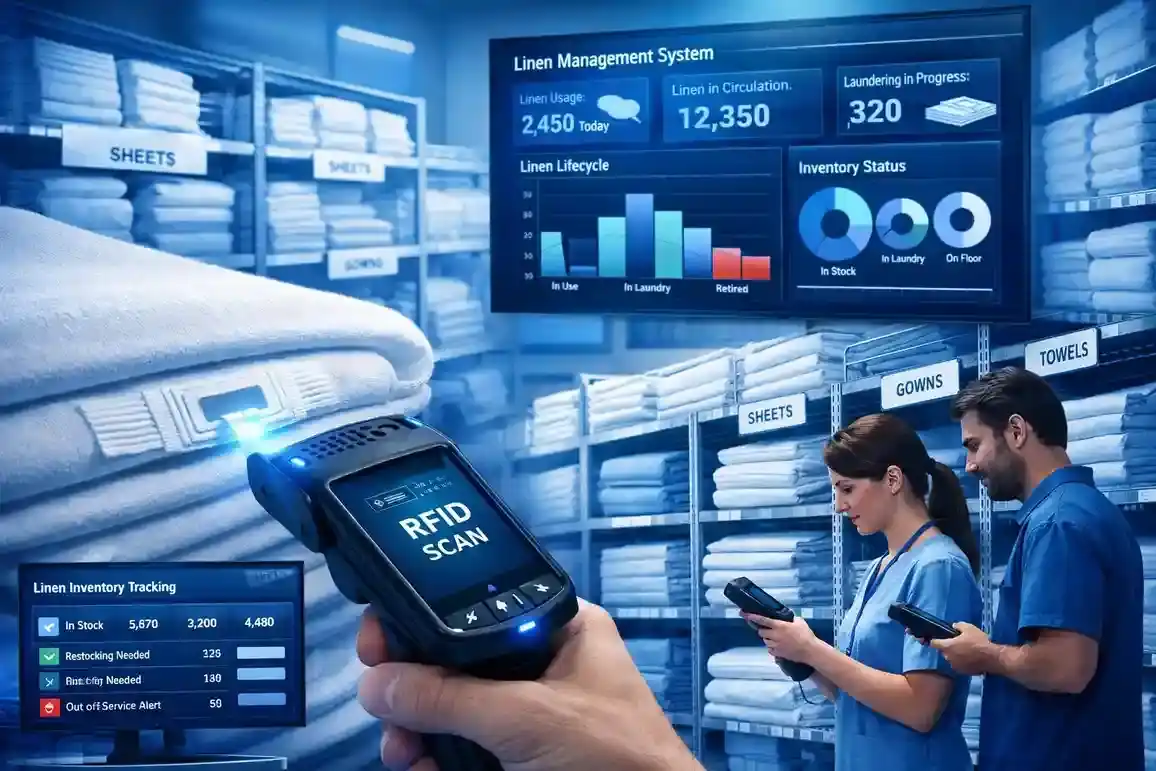
RFID, which stands for Radio Frequency Identification, uses small electronic tags embedded or sewn into individual linen items. Each tag carries a unique identifier that can be read by scanners placed at key points in the linen cycle, without requiring line-of-sight contact and often reading multiple items simultaneously in a matter of seconds.
In a well-designed linen management system, RFID readers are positioned at every critical checkpoint:
- At the point of soiled linen collection from wards, rooms, or departments
- At the laundry intake, logging every item entering the processing facility
- Post-wash and at the point of dispatch, confirming what has been processed and returned
- At the clean linen distribution point, recording what has been issued to each department
The system builds a continuous, real-time record of where every piece of linen is at any given moment. Any item that does not complete its expected journey through the cycle is flagged immediately, rather than being discovered weeks later during a manual count.
Beyond tracking location, RFID systems also count wash cycles per item. This enables linen to be retired from service at the correct point based on actual usage data, rather than relying on visual inspection alone or leaving worn items in circulation longer than they should be. This is particularly valuable in healthcare settings where linen integrity has direct hygiene implications, and in any facility where complete linen lifecycle management is a priority.
The Operational Benefits Go Beyond Loss Prevention
Stopping inventory leakage is the most immediate benefit of RFID linen inventory management, but it is not the only one. Once you have item-level visibility across your entire linen inventory, a range of other operational improvements become possible.
Accurate Par Level Management
When you know exactly how much linen is in circulation, how much is in the wash, and how much is in storage at any point, you can maintain par levels with precision. Facilities that previously kept large buffer stocks as protection against uncertainty often find they can reduce those stocks significantly once RFID gives them reliable real-time data. Smaller inventory requirements mean lower procurement costs and less storage space consumed.
Faster Turnaround and Better Availability
With full visibility into what is where, facilities management teams can ensure clean linen reaches the right departments at the right time without relying on manual counts or informal communication. In a hospital, this means wards are never waiting for linen at a critical moment. In a hotel, it means housekeeping runs to schedule without shortages during peak occupancy or high-turnover periods.
Audit Readiness and Compliance Documentation
RFID systems generate a complete, timestamped log of every item's movement and processing history. For hospitals working towards NABH accreditation, this documentation is invaluable. For any facility subject to periodic inspection or internal audit, having an accurate, exportable inventory record at any point removes a significant administrative burden.
Sustainability Gains
Better inventory visibility also supports sustainable laundry operations. When linen is tracked accurately, processing facilities can optimise load sizes, reduce unnecessary wash cycles on items that do not need them, and extend the usable life of each item through timely maintenance and correctly timed retirement. Less waste, fewer replacement purchases, and more efficient processing all contribute to a lower environmental footprint across the operation.
Why Outsourced Linen Management Delivers RFID Tracking More Effectively
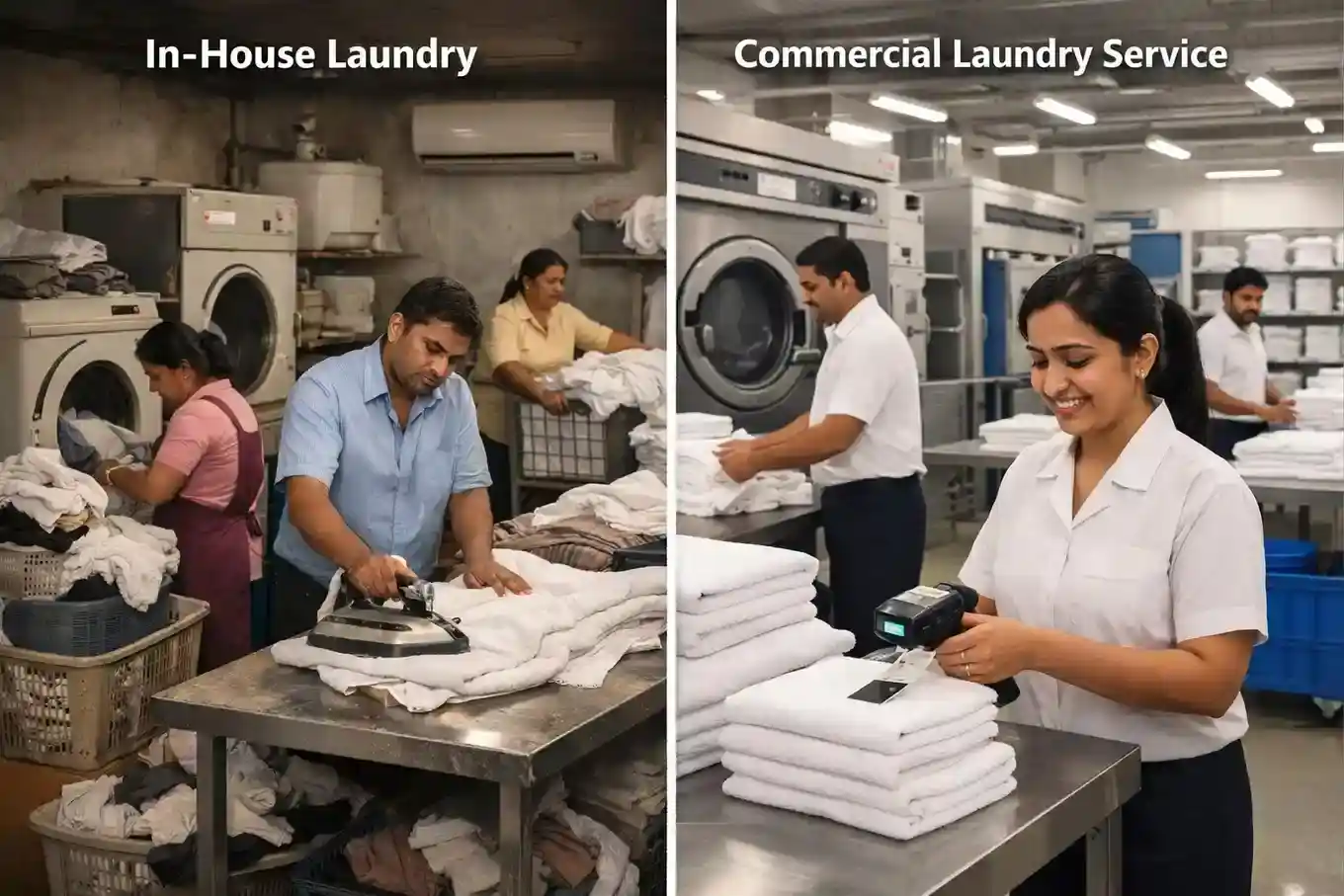
Implementing RFID tracking independently is not a simple undertaking. Beyond the cost of the tags themselves, you need readers at multiple checkpoints, software to manage and interpret the data, integration with your existing systems, and staff trained to use the technology correctly. For most large facilities, building all of this in-house is neither cost-effective nor a good use of management bandwidth.
This is one of the strongest arguments for outsourced linen management with RFID built in. When you work with a provider that has already invested in the technology and the infrastructure, you benefit from full tracking capability without carrying the capital cost or the operational complexity of running it yourself.
The commercial laundry services model, where a specialist provider handles processing, tracking, inventory management, and quality control as a combined service, is increasingly the way large facilities are choosing to manage linen. It converts a complex, multi-variable operational function into a single managed service with clear accountability and measurable outcomes.
The Zero Capital Linen Solution: Taking It One Step Further
For facilities that want to eliminate linen-related capital expenditure entirely, a zero capital linen solution takes the outsourced model to its logical conclusion. Under this arrangement, the service provider owns the linen inventory outright. The facility pays for access to clean, quality-maintained, fully tracked linen as a service, with no upfront procurement cost, no replacement budget to manage, and no depreciation to account for.
Complete linen lifecycle management sits entirely with the provider. They tag and track every item from the moment it enters service, monitor wash counts and condition, repair or replace items as needed, and retire linen at the end of its useful life, all without any involvement required from the facility's side. The facility always has access to linen that meets the required standard, and the cost is entirely predictable.
For procurement managers and CFOs, this model converts an unpredictable capital and operational expense into a clean, auditable line item. For operations teams, it removes an entire category of management responsibility from their plate.
How Quick Smart Wash Delivers This End to End
Quick Smart Wash has been building and operating linen management solutions for hospitals, institutions, and large facilities across India for over 13 years. RFID-based linen tracking is a core part of their service offering, not a feature that is bolted on after the fact.
Every piece of linen processed through their system is tagged and tracked across its full lifecycle. Clients get real-time inventory visibility, wash count data, condition monitoring, and full processing records. Their high-capacity automated laundry plants ensure that commercial laundry services are delivered at the scale and consistency that large facilities require, while RFID tracking keeps every item accounted for at every stage.
For facilities that want to go further, Quick Smart Wash offers a zero capital linen solution where they own and manage the linen inventory entirely, covering procurement, tagging, processing, quality control, and end-of-life replacement. The facility gets complete linen lifecycle management as a service, with all capital and operational costs absorbed by the provider.
They can also set up and operate a fully managed laundry facility on your premises if on-site processing is preferred, with all infrastructure, staffing, and technology provided and operated by their team.
Visibility Is the Starting Point for Everything Else
Linen leakage is not a problem that gets better on its own. Left unaddressed, it grows quietly and consistently, draining procurement budgets, creating availability gaps, and making it impossible to manage inventory with any real confidence.
RFID linen inventory management gives facilities the visibility they need to bring this under control. And when that technology is embedded in a fully outsourced linen management model, the benefits extend well beyond loss prevention, touching compliance, sustainability, cost predictability, and operational efficiency all at once.
If your facility is still managing linen inventory manually or working with a provider that does not offer tracking, it is worth asking what that is actually costing you.
About Md Shaquib
Md Shaquib enjoys blogging and content writing, sharing useful stories and tips online.