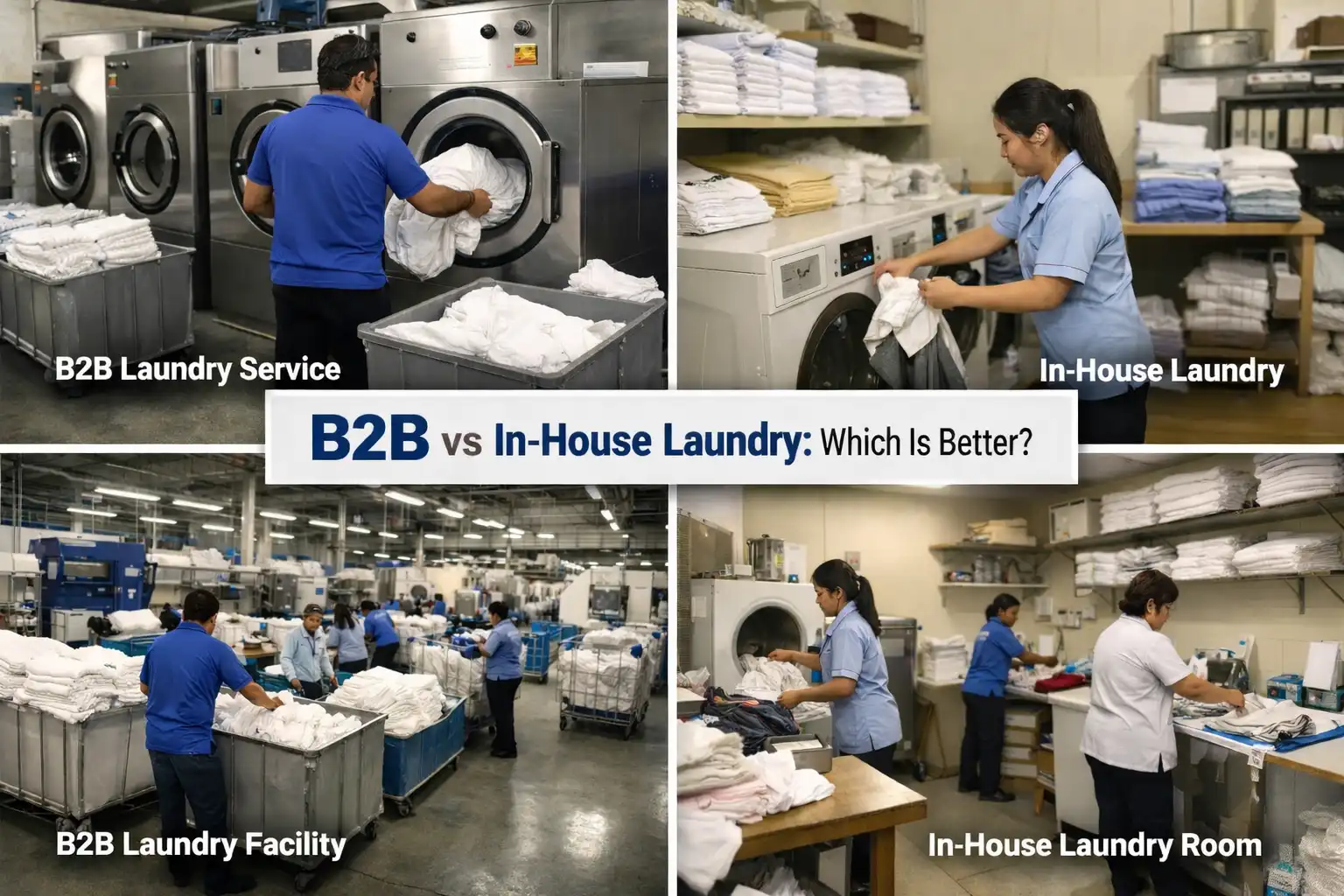
Any organisation that processes linen at volume faces the same foundational decision at some point: manage laundry operations in-house or partner with a B2B laundry services provider. It looks like a straightforward cost question. In practice, it involves capital expenditure, staffing, quality consistency, compliance readiness, scalability, and sustainability, all at once.
Hospitals, hotels, and educational institutions across India are asking this question with increasing urgency as operational costs rise and standards tighten. This blog works through both options honestly, covering the real trade-offs on each side so the decision is made on the right basis.
What In-House Laundry Actually Costs
The appeal of in-house laundry is control. You own the process, you set the schedule, and you are not dependent on a third party. For organizations with dedicated facilities, consistent volumes, and a team to manage it, that control is real.
The problem is that the true cost of exercising that control is considerably higher than the surface cost suggests. Capital expenditure on industrial washers, dryers, finishing equipment, and infrastructure is substantial upfront. Then the ongoing costs begin: maintenance contracts, emergency repairs, staff salaries and cover during leave, detergent and chemical procurement, water, electricity, and dedicated floor space that could serve another purpose.
Beyond the money, there is the management overhead. Someone has to oversee scheduling, quality, compliance, and breakdowns. During a busy period, whether that is high hospital occupancy, a hotel at full capacity, or an educational institution at the start of a new term, the laundry operation cannot scale down just because the team is stretched.
Hidden costs pile up consistently in ways that are rarely captured accurately in the initial business case for going in-house:
What B2B Laundry Services Change
B2B laundry services transfer the operational responsibility of linen processing to a specialist provider. The organisation receives clean, quality-checked linen on a reliable schedule and pays a service fee rather than carrying the full weight of running a laundry operation.
In practical terms, this means no capital expenditure on equipment, no maintenance overhead, no replacement costs when linen wears out, and no management bandwidth consumed by scheduling, compliance, and breakdowns. The processing is handled by a team built and equipped specifically for this function.
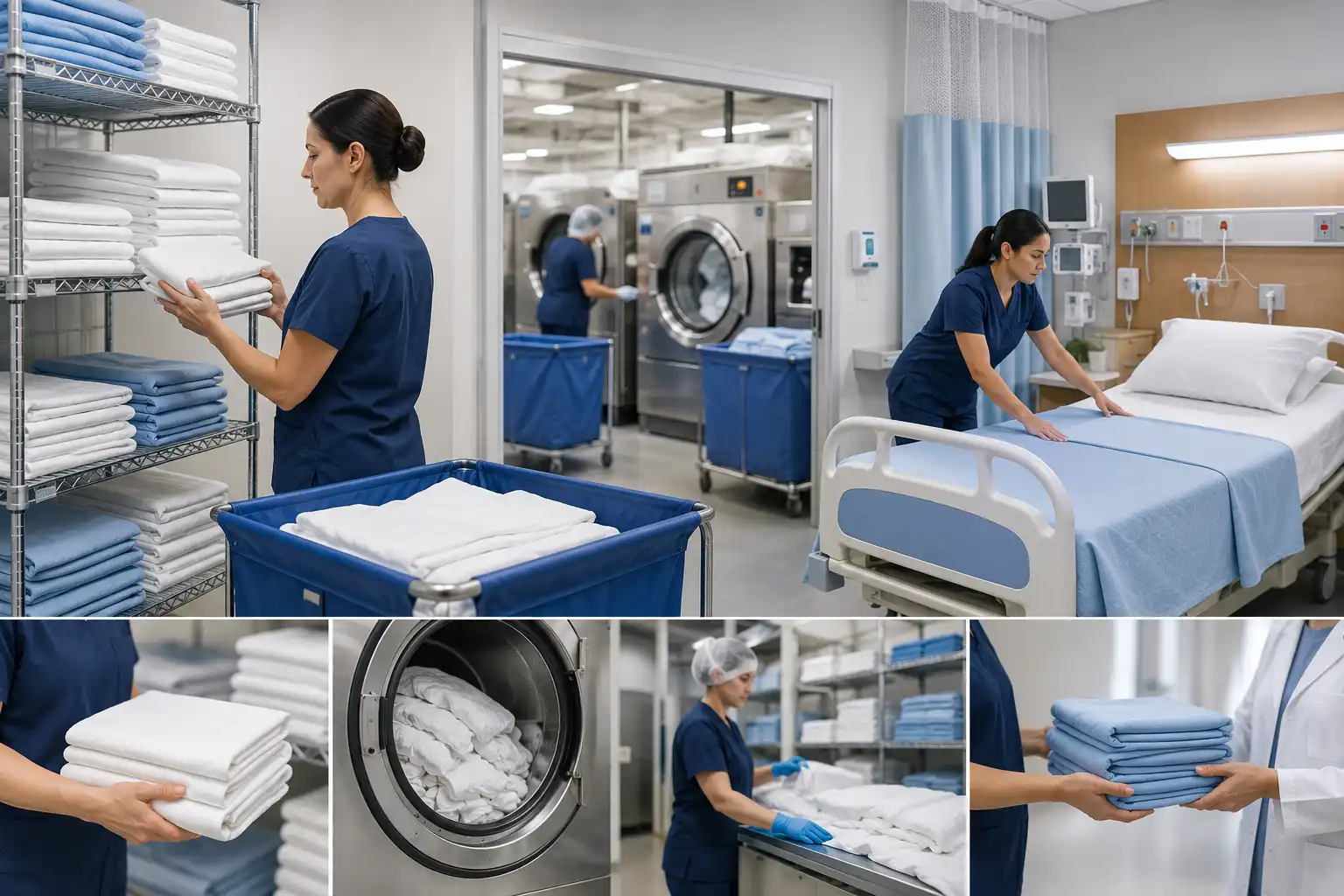
For hospitals, this means clinical teams always have the linen they need, processed to infection control standards, without the procurement and infrastructure burden. For hotels, it means housekeeping operates consistently without being exposed to the variability of an in-house setup under pressure. For educational campuses, it means a reliable, hygienic laundry service that runs without competing for management attention.
The Honest Comparison
Here is how the two models compare across the dimensions that matter most to operations and procurement teams.
| Factor | In-House Laundry | B2B Laundry Services |
|---|---|---|
| Capital investment | High: equipment, installation, infrastructure | None required from the organization |
| Ongoing cost | Variable: staff, utilities, maintenance, replacement | Single predictable service fee |
| Quality consistency | Variable, depends on staff and equipment condition | Consistent, validated processes every time |
| Scalability | Fixed by equipment and staffing capacity | Scales with demand, no restructuring needed |
| Compliance documentation | Hospital-managed, often incomplete | Continuously maintained by the provider |
| Sustainability | Difficult to optimize at smaller scale | Industrial efficiency, water recycling, eco-chemistry |
| Management burden | Ongoing across staffing, compliance, quality | Minimal, sits with the provider |
The Quality and Compliance Argument
For organizations in sectors with non-negotiable hygiene standards, the quality argument for B2B laundry services goes beyond convenience. In healthcare, linen that has not been processed to validated disinfection standards is a patient safety risk, not just a quality issue. In hospitality, linen that is inconsistently processed affects the guest experience in ways that show up in reviews. In education, shared residential linen processed without proper hygiene controls creates health risks across the student population.
Premium laundry services delivered by a specialist provider operate under defined quality protocols that do not fluctuate based on who is working that day or whether the equipment is running well. Every load goes through the same validated process. That consistency is genuinely difficult to replicate in-house under the operational pressures of a busy institution.
Compliance documentation is another dimension where professional providers have a structural advantage. Accreditation requirements, whether NABH for hospitals or green certification programmes for hotels, increasingly require evidence of structured, auditable processes. A specialist B2B laundry services partner generates this documentation as a standard output of normal operations.
Sustainability: Where Scale Makes the Difference
In-house laundry operations at institutional scale are inherently difficult to run sustainably. Partial loads, older equipment, inconsistent chemical dosing, and limited investment in water recycling infrastructure all push resource consumption higher than it needs to be.
Sustainable laundry solutions delivered through a purpose-built commercial facility are more efficient by design. Industrial-grade machines optimized for full loads, water recycling systems that recover the majority of processed water for reuse, biodegradable detergents dosed precisely through automated systems, and energy sourcing that moves away from fossil fuels all combine to produce a meaningfully lower environmental footprint per kilogram of linen processed.
For organizations building out ESG reporting or working toward sustainability certifications, partnering with a B2B laundry services provider that has made these investments gives them something concrete and credible to include in their documentation, rather than aspirational statements about in-house improvements that are slow to materialize.
When In-House Laundry Still Makes Sense
There are situations where in-house laundry is the right call. Very large facilities with the volume to justify dedicated industrial infrastructure, a skilled team to manage it properly, and the capital to maintain it to a high standard can make it work. The control it provides is real, and for organizations where turnaround speed and on-site visibility are the overriding priorities, building and running your own operation has merit.
The honest question to ask is whether your organization consistently meets those conditions. Many that start with in-house laundry find that the operation degrades over time as investment is deferred, staff turnover affects quality, and the management overhead grows. The decision that made sense at opening becomes harder to justify three years in.
How Quick Smart Wash Structures Its B2B Laundry Services
What sets Quick Smart Wash apart as a B2B laundry services provider is that the service is structured around the operational realities of large institutions rather than adapted from a general commercial laundry model. Hospitals, hotels, and educational campuses across India have different linen volumes, different hygiene requirements, and different operational constraints. Quick Smart Wash works around each of these rather than asking clients to fit a standard arrangement.
For organizations that want on-premises processing, Quick Smart Wash sets up and operates a fully managed laundry facility within the client's own premises, covering all capital expenditure, equipment, staffing, and operational management. The organisation gets the control of on-site processing without carrying any of the infrastructure or management burden.
For those that prefer off-site processing, linen is collected, processed at Quick Smart Wash's central processing units, and returned fully finished and ready for use. RFID-based tracking maintains complete inventory visibility throughout. Linen rental is also available, converting procurement and lifecycle management into a single managed service.
Across all models, Quick Smart Wash operates with premium laundry services standards: validated hygiene protocols, eco-friendly detergents, water recycling systems, and energy-efficient processing that positions sustainable laundry solutions as the default rather than an add-on.
The Decision Comes Down to What You Are Actually Comparing
Most organizations that choose in-house laundry are comparing the service fee of B2B laundry services against only the visible direct costs of their own operation. When the full cost is calculated properly, including capital, utilities, maintenance, staffing, replacement, compliance, and management time, the gap between the two options narrows considerably. For many, it disappears entirely.
The organizations that benefit most from making the switch are those that recognise laundry as a specialist function that deserves specialist management. Freeing internal teams from operational responsibility for linen, and replacing unpredictable cost variability with a single accountable service arrangement, tends to pay off on multiple dimensions at once.
If your organization is still carrying the full weight of in-house laundry and starting to feel the friction, it is worth working through the true cost comparison before assuming the current model is the right one.