Ask any hospital administrator about their biggest operational headaches and hospital linen management will appear on the list more often than most people expect. Missing inventory, wards running short at the wrong moment, linen staying in circulation past its useful life, and no reliable way to know where anything is at any given time.
For a long time, these problems were managed through manual counts, informal tracking, and a lot of buffer stock purchased to compensate for losses that nobody could accurately quantify. That approach is expensive, inconsistent, and increasingly difficult to defend in an environment where hospitals are expected to demonstrate structured, auditable linen management practices.
Technology is changing what is possible. Comprehensive hospital linen management today looks very different from what it did ten years ago, and the hospitals that have adopted modern systems are seeing measurable improvements across cost, hygiene compliance, and operational reliability.
The Problem with Manual Linen Management
Manual hospital linen management is not just slow. It is structurally unable to give hospitals the visibility they need. When inventory is tracked through handwritten logs, periodic physical counts, and informal communication between wards and laundry teams, the data is always out of date and often incomplete.
- Linen loss rates of 15 to 30 percent annually are common in hospitals relying on manual tracking
- Ward-wise linen distribution becomes guesswork when nobody knows exactly what is in circulation versus what is in the wash
- Worn or damaged items stay in use because there is no system flagging wash count thresholds
- Compliance documentation is difficult to produce because records were never maintained continuously
- Staff time is consumed chasing shortages and resolving discrepancies rather than supporting patient care
How RFID Linen Tracking Changes the Picture
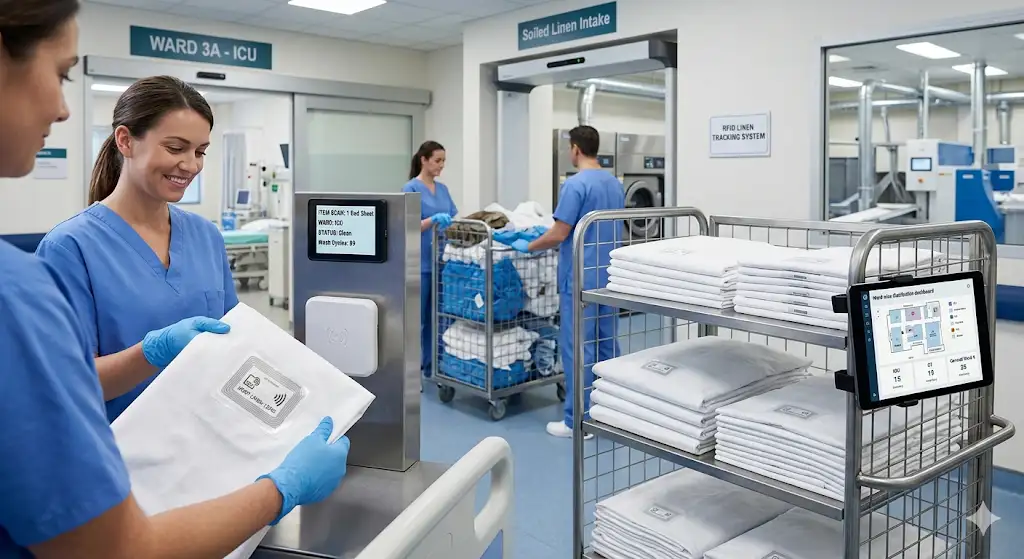
RFID hospital linen tracking embeds a small electronic tag into each individual linen item. The tag carries a unique identifier that is read by scanners placed at key points in the linen cycle, without requiring manual scanning or line-of-sight contact. Multiple items can be read simultaneously in seconds.
Scanners positioned at ward collection points, laundry intake, post-processing dispatch, and clean linen distribution build a continuous, real-time record of every item's location and status. The result is a live view of the entire linen inventory that no manual system can replicate.
What RFID hospital linen tracking delivers in practice:
- Every piece of linen is traceable at every point in its journey, from soiled collection to clean return
- Items that do not complete its expected cycle are flagged immediately, making losses visible in real time rather than discovered during an annual count
- Wash cycle counts per item are recorded automatically, enabling retirement decisions based on data rather than visual inspection alone
- Par levels per ward can be managed accurately because inventory data is current, not days old
Ward-Wise Linen Distribution: Getting the Right Linen to the Right Place
One of the most common and avoidable failures in hospital linen management is the wrong linen ending up in the wrong ward. OT linen mixed into general ward inventory. ICU-specific items distributed to other departments. Surplus in one area while another is running short. Comprehensive hospital linen management addresses all of this through structured, technology-backed workflows rather than manual sorting and informal handoffs.
Technology-driven ward-wise linen distribution solves this through tagging that identifies not just individual items but their designated category and intended location. Distribution is tracked against ward-specific requirements. Shortfalls are visible before they become operational problems rather than after a nurse reports there are no clean gowns.
For high-volume facilities with multiple wards, departments, and specialised linen categories, accurate ward-wise linen distribution is not a luxury. It is what makes reliable linen availability possible at scale.
What Technology-Backed Linen Management Delivers
The operational benefits of moving from manual to technology-supported hospital linen management compound across multiple dimensions.
Reduced Linen Loss
When every item is tracked and losses are visible in real time through RFID hospital linen tracking, shrinkage drops significantly. Hospitals that have implemented RFID systems consistently report linen loss reductions of 30 to 40 percent. At the procurement cost of clinical linen, that saving is meaningful.
Lower Procurement Costs
Accurate inventory data means hospitals stop over-purchasing to compensate for losses they cannot track. Par levels are set on real usage data rather than estimates, which eliminates both shortages and excess stock that sits in storage and degrades.
Better Hygiene Assurance
Tracking wash cycle counts per item means linen that has reached its maximum recommended cycles is automatically flagged for retirement. Items do not stay in circulation until they visibly fail. They exit the system based on objective data, which protects both fabric quality and hygiene standards.
Audit-Ready Compliance Documentation
Every movement, every wash cycle, every ward-wise linen distribution event is timestamped and stored. For NABH accreditation or any quality audit requiring evidence of structured linen management, this documentation is generated continuously as part of normal operations rather than assembled under pressure before an inspection.
Staff Time Redirected to Patient Care
When inventory is tracked automatically and distribution is managed through data rather than guesswork, nursing and housekeeping staff spend significantly less time chasing linen or resolving shortages. That time goes back to where it should be.
Technology at the Core of Quick Smart Wash's Hospital Linen Operations
Delivering comprehensive hospital linen management is what Quick Smart Wash's systems are built around. RFID hospital linen tracking is a standard part of their service, not an optional feature. Every item processed through their system is tagged and scanned at each stage of the cycle, giving hospital administrators a real-time view of their linen inventory across collection, processing, and ward distribution.
Wash cycle data per item supports retirement decisions based on actual usage rather than guesswork. Ward-wise distribution records are maintained continuously and available for compliance reviews. And because the tracking system operates across the full linen lifecycle, from soiled collection through to clean return, hospitals get the complete picture that comprehensive hospital linen management requires.
For hospitals that want processing on-site, Quick Smart Wash sets up and operates a fully managed laundry plant within the hospital, with tracking infrastructure included. For those using their central processing units, the same hospital linen management visibility is maintained throughout the off-site cycle. Either way, the hospital always knows where its linen is.
The Shift from Managing Linen to Knowing Where It Is
The difference between manual and technology-driven hospital linen management is not just efficiency. It is the difference between reacting to problems and preventing them.
Hospitals that know where their linen is, how many wash cycles each item has completed, and exactly which wards are approaching a shortage are in a fundamentally different operational position than those finding out about problems after they have already created disruption on the ward.
If your facility is still managing linen on manual counts and informal tracking, the case for upgrading is straightforward. The data will tell you what you are losing. The question is how soon you want to start seeing it.